When Floor Wayfinding Is Needed
Floor wayfinding is used where people need to move quickly and make simple decisions without asking staff every few metres. That can be a retail queue lane, a clinic sign-in route, a warehouse pick path, a school corridor, or a showroom flow that needs to keep visitors moving in one direction. In busy sites around Isando, Germiston and Midrand, the right floor graphics reduce confusion and help keep foot traffic organised during peak periods.
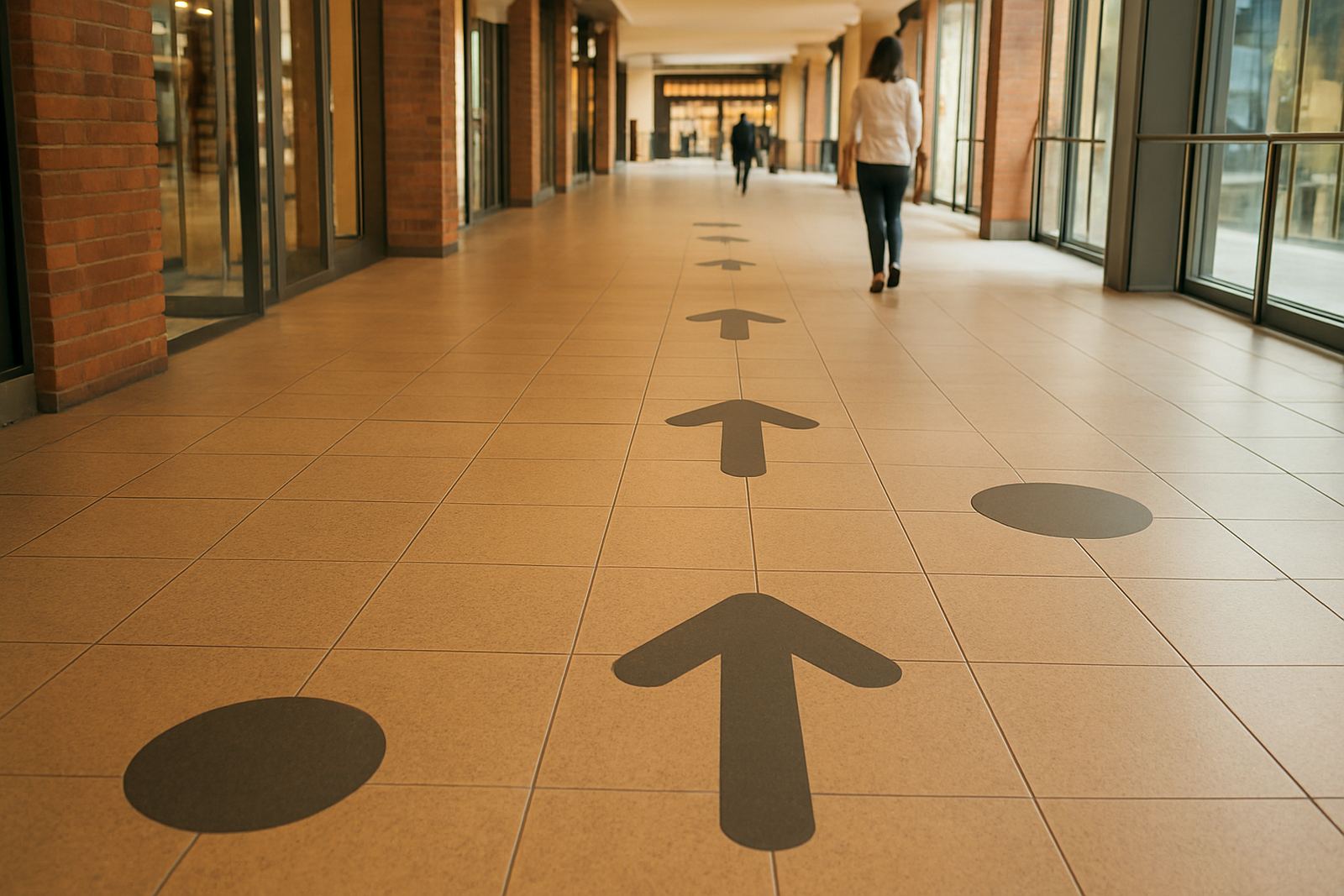
For many businesses, the need starts with safety and order. In others it is about brand control, making sure a launch, expo or public space feels planned instead of cluttered. Contour-cut arrows, footprints, box outlines and colour coded route markers all help. They must still stay readable after trolleys, cleaning chemicals and daily traffic, otherwise they become decoration rather than a tool.
- Queue lanes for reception, pay points and collections
- Visitor routes through warehouses, factories and showrooms
- Branded paths for promotions, launches and events
- Directional markers for stairways, entrances and exits
The Right Equipment and Material Set
Floor wayfinding depends on the right print-and-cut setup. The artwork must be cut cleanly, with registration calibration set properly so the printed image and cut line match exactly. If the plotter is out by even a few millimetres, letters and arrows start to look untidy and installation becomes slower. That matters when you are producing small batches for different branches or repeating a standard layout across multiple sites.
Typical floor graphics jobs use printed vinyl with a hard-wearing overlaminate, then contour cut into arrows, icons, footprints or text panels. On smoother indoor floors the material choice is usually different from what you would use on textured concrete or sealed industrial floors. For humid coastal deliveries, extra care is needed with adhesive choice and curing time. In Gauteng, dust and load-shedding interruptions can also affect print handling and finishing, so production needs a steady process.
- Print-and-cut contour plotter with accurate registration reading
- Compatible floor vinyl and anti-slip protective overlaminate
- Clean cutting blade and correct pressure setting for edges
- Dry, dust-free finishing space for trimming and packing
- Basic test panels before full production runs
Our team supports operator induction, blade pressure setup, media loading, maintenance basics and troubleshooting sessions so your crew can handle day-to-day production with confidence.
Layout Planning That Keeps People Moving
A good layout starts with the building, not the graphics. You need to understand where people enter, where they pause, and where they should not be walking. In a warehouse, that means avoiding forklift lines and stacking zones. In a clinic or office, it means guiding visitors past reception without blocking emergency access. In a retail setting, the floor route should work with the queue and not against it.
Before cutting anything, measure the floor carefully and map the route on site. Check tile joints, floor lifts, expansion gaps and cleaning patterns. These small details affect whether the graphic sits flat and stays neat. We usually advise clients to think in metres rather than in individual decals only, because the spacing between signs is what gives the route its flow. A route that is too busy looks confusing, while one with too few markers gets ignored. It sounds simple, but people move fast and often miss the obivious if the sequence is weak.
- Use simple arrows, numbers and words that can be read at a glance
- Keep colours consistent for each zone or route type
- Allow enough spacing between markers for natural walking pace
- Confirm municipal or landlord rules for floor fixings in public areas
- Test the route with staff before final production
Common Mistakes That Cost Time and Money
One common mistake is choosing a graphic that looks good in the artwork file but fails on the floor. Fine details can lift or wear early if the cut is too small or the film is not suitable for foot traffic. Another mistake is using the same floor solution across all sites. A shopping centre entrance, an air-conditioned office and a dusty industrial bay all need different material choices and different installation handling.
Another problem is poor installation timing. Floors should be properly cleaned and allowed to dry, and busy areas often need after-hours fitting. In places with load-shedding, production teams also need to plan finishing and curing around power interruptions so pieces are not rushed. If the floor is still damp or dusty, edges can fail early. If the route is placed too close to a door swing, a counter or a pallet run, it will not last. That part is simple but many teams still get it wrong.
- Do not use tiny text for directions that must be read quickly
- Do not skip surface prep, even on polished sealed floors
- Do not place markers where trolleys, pallets or doors will hit them
- Do not mix too many colours on one route
Typical Budget Ranges in Rand
Floor wayfinding budgets depend on size, material, complexity and installation. A small internal queue set with a few arrows and floor notices may start from about R3,500 to R7,500. A medium route for a branch network, reception area or warehouse section often sits between R8,000 and R18,000. Larger sites with multiple zones, custom shaped graphics and after-hours installation can run from R20,000 upward, especially when the job includes planning, production and site fitting across several locations.
If you need cutter supply support as well, we can help with operator induction, registration calibration, media loading, supervisor coaching and remote refresher sessions. That keeps in-house teams producing cleaner work and reduces waste on repeat jobs. For multi-branch rollouts from Sandton, Midrand, Boksburg, Randburg or Germiston, it is usually smarter to standardise the route system first, then reproduce it site by site instead of changing the layout each time. That saves time and keeps the finish consistent across all branches.
What Clients Usually Ask Us To Make
Most floor wayfinding briefs are practical. The client needs people to go somewhere, stop somewhere, or stay in a line without staff having to repeat instructions all day. Once the route is clear, the design can still carry branding, but the main job is function. For that reason we often keep wording short and use strong shapes that read well from standing height.
Common requests include floor arrows, entrance-to-reception guides, collection points, safe walking lines, queue start markers and branded event routes. We also handle custom cuts for temporary campaigns, so a promo can be changed out without reprinting a whole floor system. If you are planning a new site or fixing an older one, we can advise on artwork cut lines, maintenance basics and the right install method for the floor type.
- Navigation for stores, offices, clinics and schools
- Queue control for counters, tills and sign-in points
- Warehouse routes and pedestrian safe zones
- Temporary branded paths for activations and launches