Industrial safety markers for a Germiston site
This project came from an industrial business in Germiston that needed safety markers for a production and storage area with a lot of moving parts. The brief was straightforward: make warning labels and cut markers that could be read quickly, stay in place, and help staff identify zones, equipment points and safe handling areas without slowing down the workflow.
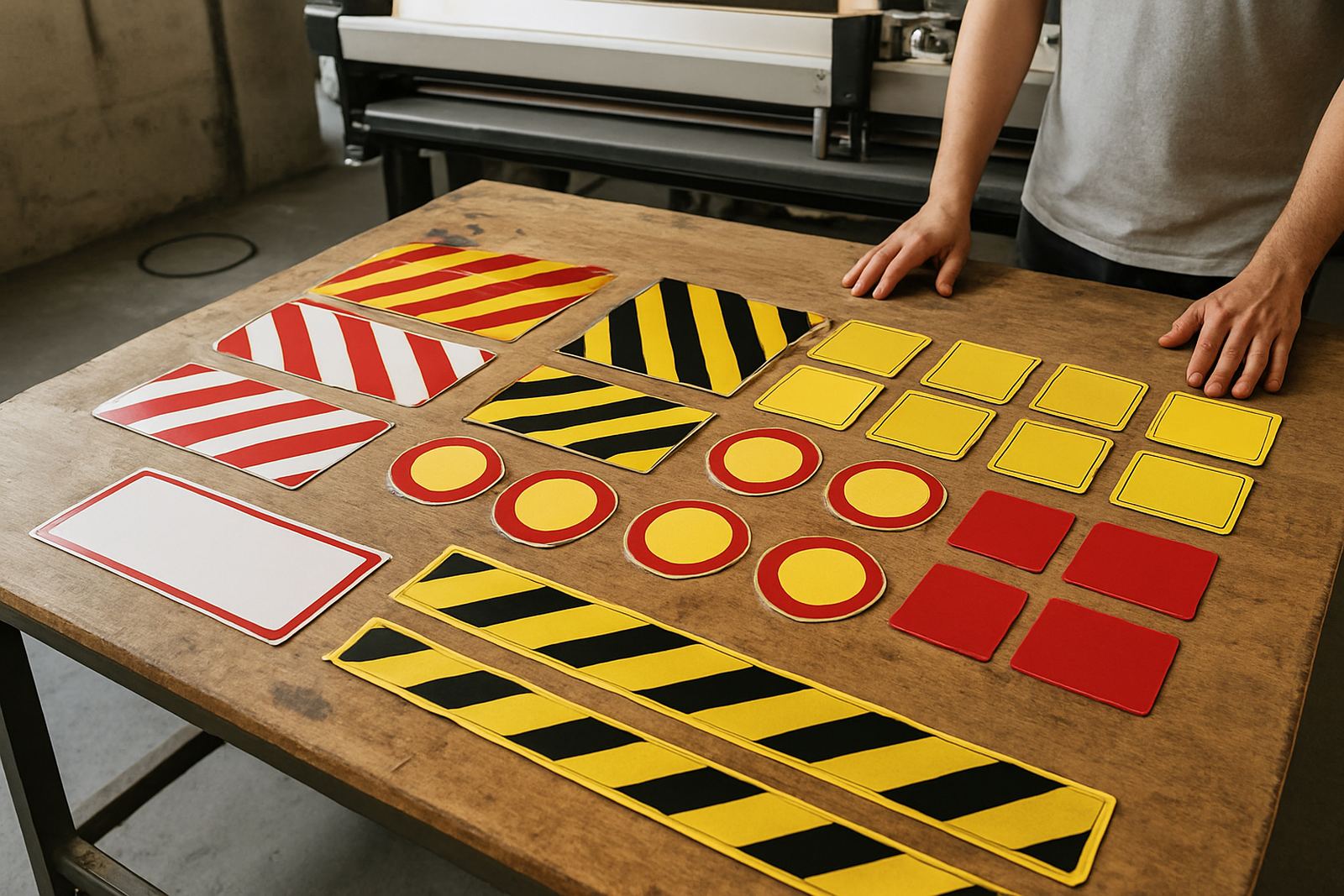
Because the site runs long shifts and has mixed lighting in parts of the building, the client wanted reflective items that would still be visible when the main lights were dimmed or when forklifts moved through shadowed aisles. The final set included cut-to-shape markers, directional labels and reflective warning graphics sized for walls, machines and floor-edge points.
- Client type: Industrial manufacturing and warehousing
- Town: Germiston, Gauteng
- Use case: Safety marking, identification and warning control
What the brief needed to solve
The client did not want loose, temporary looking signage. They wanted a clean system that could be understood by operators, supervisors and maintenance staff at a glance. The artwork had to stay readable at short and medium distance, and the shapes had to be cut cleanly so each label looked intentional rather than generic.
There were also practical constraints. The site has regular cleaning, exposure to dust and some areas with mild vibration from machinery. On top of that, the client needed the labels produced quickly because a safety audit was coming up in the following week. We had to keep the file prep, cutting and finishing tight so the installation could happen without interrupting production. It was a fairly focused job, but the timing was strict.
- Short turnaround for an upcoming audit
- Visibility needed in mixed light and shadow
- Materials had to handle dust, cleaning and handling
Materials, sizing and cut detail
We supplied reflective vinyl safety labels cut to the required shapes, plus a set of precision markers for zones and key points on the floor and equipment. The main labels were produced in standard industrial warning sizes, with smaller identification pieces for cabinets and machine areas. Cut lines were cleaned up before production so each edge stayed neat after trimming.
The reflective face stock was selected for visibility under workshop lighting and vehicle movement. We used a pressure-sensitive adhesive suited to smooth painted metal, sealed panels and prepared flat surfaces. For the cut markers, the corners were softened where needed so they would wear better under day-to-day use. One or two of the smaller items needed a second pass on sizing because the client’s mounting points were tighter than first measured, but we caught that before final output.
- Reflective warning labels for higher visibility
- Cut markers for equipment, zones and routes
- Adhesive chosen for painted metal and sealed panels
- Finished edges prepared for quick application
Production and checking before delivery
Once the artwork was approved, the production path moved in a simple sequence. Cut lines were checked, media was loaded, blade pressure was adjusted and the registration points were calibrated before the main run started. That reduced waste and kept the labels consistent across the full set. The run was completed over two weeks from brief to handover, which included artwork prep, cutting, sorting and a final quality check.
We also verified that the reflective elements stayed aligned across repeated cuts so there were no odd shifts between batches. For an industrial site, that sort of consistency matters because a label that is off by a few millimetres can look untidy once it is installed beside machinery or cabling. The final stack was packed by zone so the client could install each group in the right place without sorting through mixed sheets.
- Timeline: 2 weeks from brief to handover
- Registration and cut alignment checked during production
- Output grouped by zone for easier site application
Results on the floor at Germiston
After installation, the client had a much clearer safety marking system across the work areas. The warning labels stood out better in low light, and the cut markers gave supervisors a faster way to point staff toward the correct handling points and restricted areas. That made daily communication easier, especially during changeovers and end-of-shift clean-down.
The client also reported that the labels looked more professional than their previous mix of handwritten and off-the-shelf markers. That matters in an industrial setting because clearer marking supports safer movement and keeps people from second-guessing where a trolley, pallet or machine part should go. The whole area just read better, and it saved time during checks.
- Improved visibility in dimmer sections of the site
- Cleaner identification for zones and equipment points
- Better support for safety checks and staff movement
What we would repeat on the next safety run
If we were doing this kind of job again for another Germiston or Johannesburg site, we would follow the same approach: confirm the mounting surfaces first, measure the viewing distance, and group the labels by location before cutting starts. That avoids rework and helps the client install everything in a steady sequence instead of mixing signage from different departments.
We would also keep the reflective grade, label sizing and adhesive choice matched to the site conditions from the start. For workplaces with load-shedding, changing light or outdoor loading bays, those details make a real difference. A safety marker should do its job without needing a second thought, and it should still look right after a bit of use. That is the standard we worked to here, and it is the one we would carry through again.
- Confirm surface type before production
- Measure sightlines and lighting conditions
- Match adhesive and reflective stock to the site
Key facts
| Project type | Reflective warning labels and cut markers |
|---|---|
| Client area | Germiston, Gauteng |
| Application | Industrial safety marking for production and storage areas |
| Materials | Reflective pressure-sensitive vinyl |
| Timeline | 2 weeks from brief to handover |
| Service support | Artwork cut lines, media loading, blade setup, calibration and troubleshooting |